
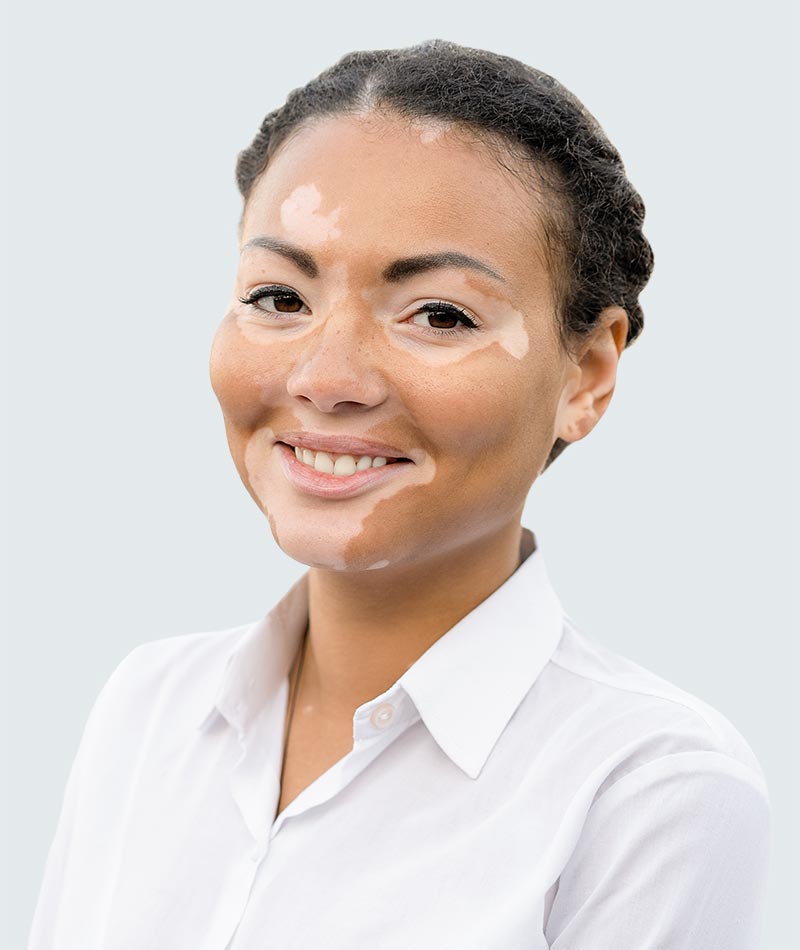
 Vitiligo is a condition that causes the skin to lose its pigmentation or color. Some people only develop a few spots that may lighten or turn completely white. Others might experience a widespread loss of color.
Vitiligo usually affects the skin, but it can develop anywhere we have pigment. Patches of hair can turn white. Some people lose color inside their mouths. Even an eye can lose some of its color. While vitiligo can affect all parts of the skin, it typically begins on the hands, forearms, feet, and face. Vitiligo can affect all races and genders, but it more noticeable in people with darker skin.
Types of Vitiligo
Generalized Vitiligo
Generalized vitiligo is the most common type. Often generalized vitiligo starts with a rapid loss of pigmentation and typically appears first on the hands, fingertips, wrists, around the eyes or mouth, or on the feet. Cycles of pigment loss, followed by times with no pigment change may continue through the person’s life. Generalized vitiligo can spread to the face, lips, hands, arms, or genitals.
Generalized vitiligo is often referred to as bilateral vitiligo because it causes loss of skin pigmentation on both sides of the body.
Segmental Vitiligo
Segmental vitiligo is called such because pigmentation loss tends to be confined to one segment of the body. A segment of hair on the head, an eyelash, or an eyebrow may turn white, and is almost always on just one side of the body. This type of vitiligo begins at an early age and only progresses for a year or two.
Trichrome Vitiligo
Trichrome vitiligo is characterized by the development of three shades of color – brown, tan, and white – on the skin.
Treatment
Light Therapy
Light therapy uses lights to repigment the skin. During this treatment, a patient may sit in a light box (which is used for widespread vitiligo) or receive excimer laser treatments (which are used to treat small areas). Light therapy works best on the face and is effective for many patients, with about 70% seeing results with the excimer laser. However, results can disappear when treatment is stopped.
Creams and Ointments
Your dermatologist may prescribe a topical medicine like corticosteroids, tacrolimus, and calcipotriol to apply directly to the skin. This treatment tends to be more effective in people with darkly pigmented skin and often is most effective on the face.
Depigmentation
For patients with widespread vitiligo, depigmentation is a treatment that might be recommended. This involves removing the remaining pigment from the skin to achieve a single skin color. This treatment is considered permanent.
Camouflage
Some patients with vitiligo prefer to camouflage their condition. For people with fair-skin, this can be done fairly successfully by avoiding tanning, which can make areas of vitiligo barely noticeable. Others camouflage their vitiligo with things like makeup, self-tanner, or dye.