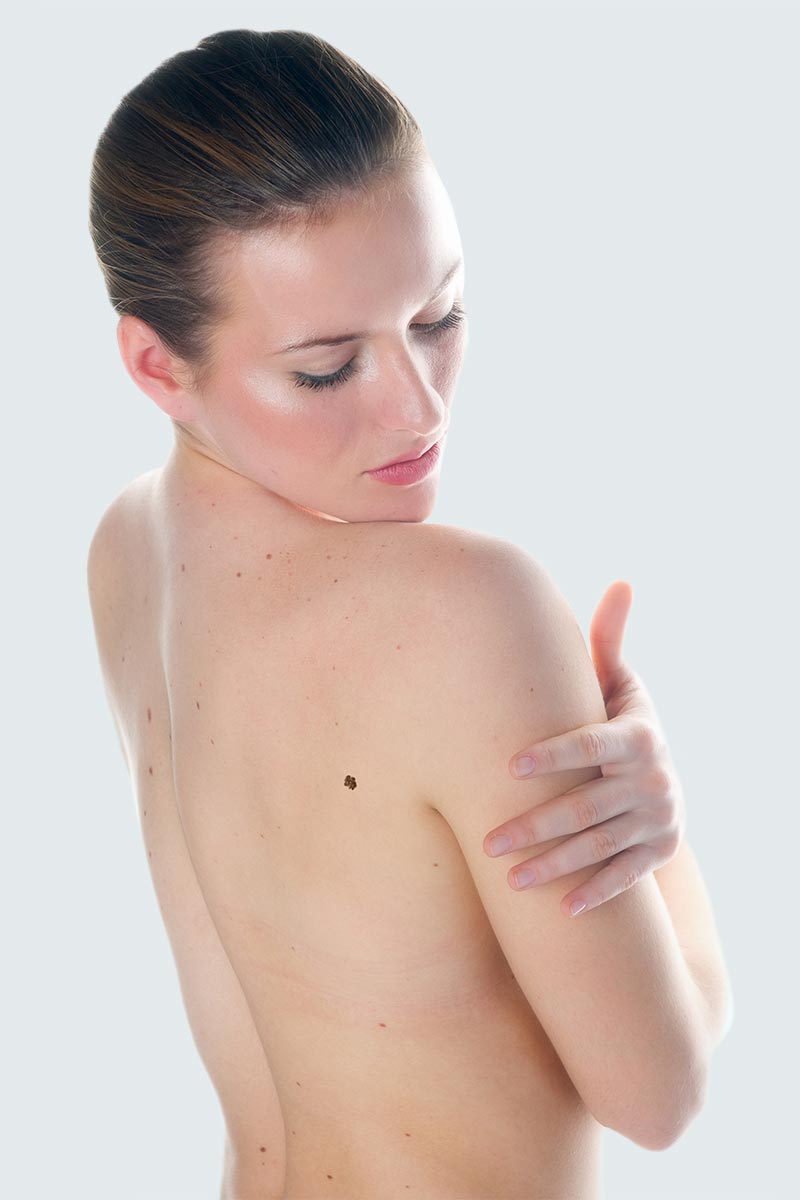
 Skin cancer is the most common cancer, with about 1 in every 5 Americans developing it in their lifetime. If caught early, skin cancer is highly treatable.
Skin Cancer Risks
We know that ultraviolet light plays a role in developing most skin cancers. For this reason, it is extremely important to practice sun protective measures. We recommend wearing a water-resistant sunscreen with at least SPF 30 everyday on sun exposed areas. Try to avoid being outdoors in the middle of the day. Try to stay in a covered, shady area if possible when outdoors. And sun protective clothing is a great, and now fashionable, option.
Anyone can get skin cancer, but some have a higher risk than others. Age is a key risk factor, but there are other factors. People with a higher risk for skin cancer have:
- Light colored skin
- Skin that burns or freckles rather than tans
- Blonde or red hair
- Blue or green eyes
- More than 50 moles
- Irregularly-shaped or darker moles
Medical history can also increase your risk of getting skin cancer. You have a great risk of skin cancer if you have:
- History of sunburns, especially blistering sunburns
- Used (or use) indoor tanning devices
- Received an organ transplant
- Had skin cancer (or have a family history of skin cancer)
- A weakened immune system
- Been exposed to cancer-causing compounds
- An area of skin that has been badly burned, either in an accident or by the sun
Types of Skin Cancer
Basal Cell Carcinoma (BCC)
Basal Cell Carcinoma is the most common type of skin cancer. It appears on the skin in many shapes and sizes. It can manifest as a dome-shaped growth with visible blood vessels; as a shiny, pinkish patch; or as a sore that heals and then returns.
BCC most often develops on skin that receives a lot of sun, like the scalp, face, nose, neck, and hands. It very rarely spread to other parts of the body; however, it does continue to grow in the skin and for this reason, it is important to be treated appropriately.
With treatment, BCC is almost completely curable. Depending on the type of basal cell you have, where it is located, and the size of your cancer, your provider may recommend different treatments for you. In general, BCC is treated with an excision of the lesion, a destructive treatment called electrodessication and curettage, Mohs surgery or a topical cream.
Squamous Cell Carcinoma (SCC)
Squamous Cell Carcinoma is the second most common type of skin cancer. SCC can appear in many different shapes, including a crusted or rough bump; a red rough flat patch; a dome shaped bump that grows and bleeds; or a sore that does not heal, or heals and returns.
SCC most often develops on skin that receives a lot of sun, like the scalp, face, nose, neck, and hands. But it can also develop on areas not exposed to the sun, such as the inside of the mouth or genitals. Left untreated, SCC can spread to other parts of the body, making treatment difficult.
However, when detected early, SCC is completely treatable. For most SCCs, we recommend surgical treatment in our office or Mohs surgery, depending on the size of the cancer and the location of the SCC. Your provider will determine which method of treatment is best for you.
Melanoma
Melanoma is the deadliest form of skin cancer. It is estimated that 1 in 75 Americans will develop Melanoma in their lifetime. It may develop on normal skin or in an existing mole. Signs of melanoma include a change in the size, color, or shape of a mole, or a mole that becomes painful or begins to bleed or itch. Some melanomas form on normal skin. A new mole or growth, particularly one that does not match your other moles, may be melanoma.
When detected early, melanoma is curable. However, if melanoma grows in the skin, it can spread to your lymph nodes, lungs and other parts of your body. For this reason, early detection is extremely important.
It is important to examine your skin regularly. If you develop a new mole or you notice a mole changing in color, size, shape, etc, then you should have that lesion evaluated. If you are diagnosed with melanoma, your provider will discuss the features of your melanoma with you. Treatment and potential increased testing will depend on the features of your melanoma.
Dysplastic Nevi (Moles)
Dysplastic nevi, or atypical moles, are benign (non-cancerous) moles that can look like melanomas. Atypical moles usually have an asymmetrical shape; an irregular and/or hazy border; varied or irregular colors; and are typically larger than 6mm. Atypical moles are most commonly found on the back, chest, abdomen, and extremities, but can also occur on the buttocks, groin, breasts, or scalp.
While dysplastic nevi are not cancerous, if you have one or more atypical moles, we know that you may be at a higher risk for developing cancerous moles. For this reason, we will recommend that you have regular total body skin exams. We also recommend that you continue to monitor your moles and let us know if you are concerned about any new or changing areas.
Actinic Keratoses (AKs)
Actinic Keratoses are common skin growths that are precancerous lesions. They are often scaly, red spots that may be tender. They most commonly occur on areas that get a lot of sun exposure, like the head, including ears, lips and scalp; arms; and hands. If left alone, a small percentage of these will progress to skin cancers (squamous cell carcinomas).
We want to treat AKs before they have the opportunity to progress to skin cancer. If there are a few lesions, we often treat with liquid nitrogen (called cryotherapy). If there are numerous AKs, your provider may discuss treating the whole area to try to get rid of the AKs that are present, as well as the AKs that may be developing under the skin. This process, called field treatment, can be accomplished by several methods, usually with prescription creams or a light treatment called photodynamic therapy. Often, we will use a combination of these treatments to treat areas with lots of sun damage and AKs. Your provider will help you to develop the best plan to treat your precancerous lesions.
Signs of Skin Cancer
Early detection is key in the treatment of skin cancer, specifically melanoma. When examining your skin, follow the ABCDEs of skin cancer to detect early signs.
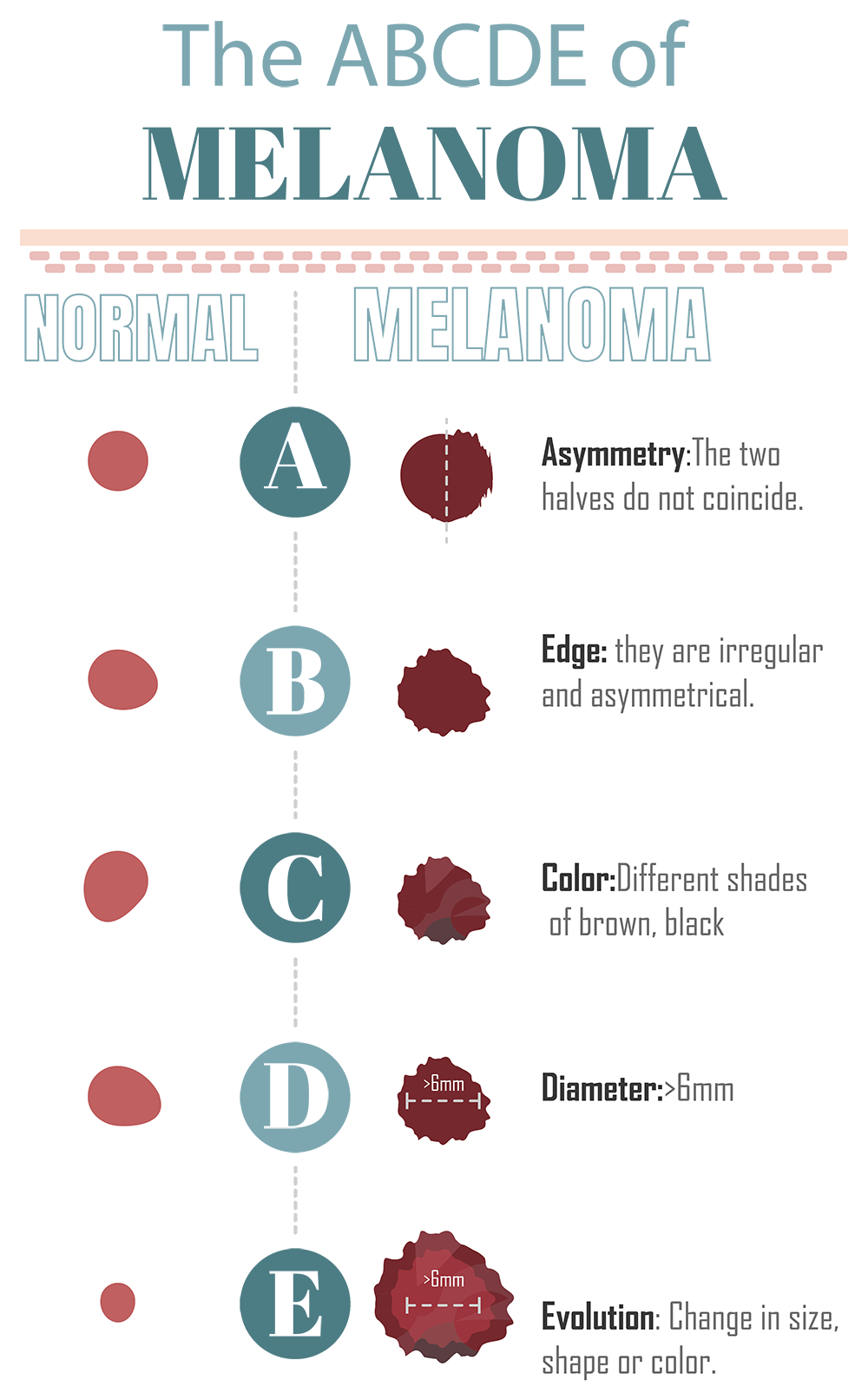
- Asymmetry: A line drawn through the middle would not create matching halves
- Border: The mole has an irregular, scalloped, or poorly defined border that fades into the surrounding skin
- Color: The color of the mole varies or is irregular from one area to another, with shades of tan, brown, dark brown, red, blue, or black.
- Diameter: Melanomas are generally larger than 6mm (the size of a pencil eraser) when diagnosed, but can be smaller.
- Evolving: A mole or skin growth that looks different from the rest or changes in appearance (size, shape, or color) should be examined by your dermatologist.
How To Self-Examine Your Skin
You should examine your skin often for changes. Remember to follow the ABCDEs of skin cancer and check for anything that is changing, itching, or bleeding.
- Examine your body (front and back) in a mirror, paying particular attention to the legs.
- Bend your elbows and carefully examine the forearms, back of the upper arms, and palms.
- Look at your feet, the spaces between the toes, and the soles.
- Examine your back and scalp with a hand mirror. Remember to check your scalp by parting your hair and lifting it away from your head.
- Check your back and buttocks with a hand mirror.
Treatment
The only way to diagnose any type of skin cancer is with a skin biopsy. Your dermatologist can perform this procedure during an office visit. To perform a skin biopsy, your dermatologist will remove the entire growth or part of it. Your dermatologist may send this to a laboratory or look at it under a microscope. The findings will be communicated in a biopsy report.
Your treatment will depend on the type and severity of your skin cancer. Your provider will discuss the available treatments and help you decide which course is right for you.
Common treatment types include excision of the lesion, electrodessication and curettage, and Mohs Surgery. Many skin cancers can be removed in our office.
However, in some cases, treatment might require a referral to another surgeon. In this case, our office will facilitate the referral for you.