
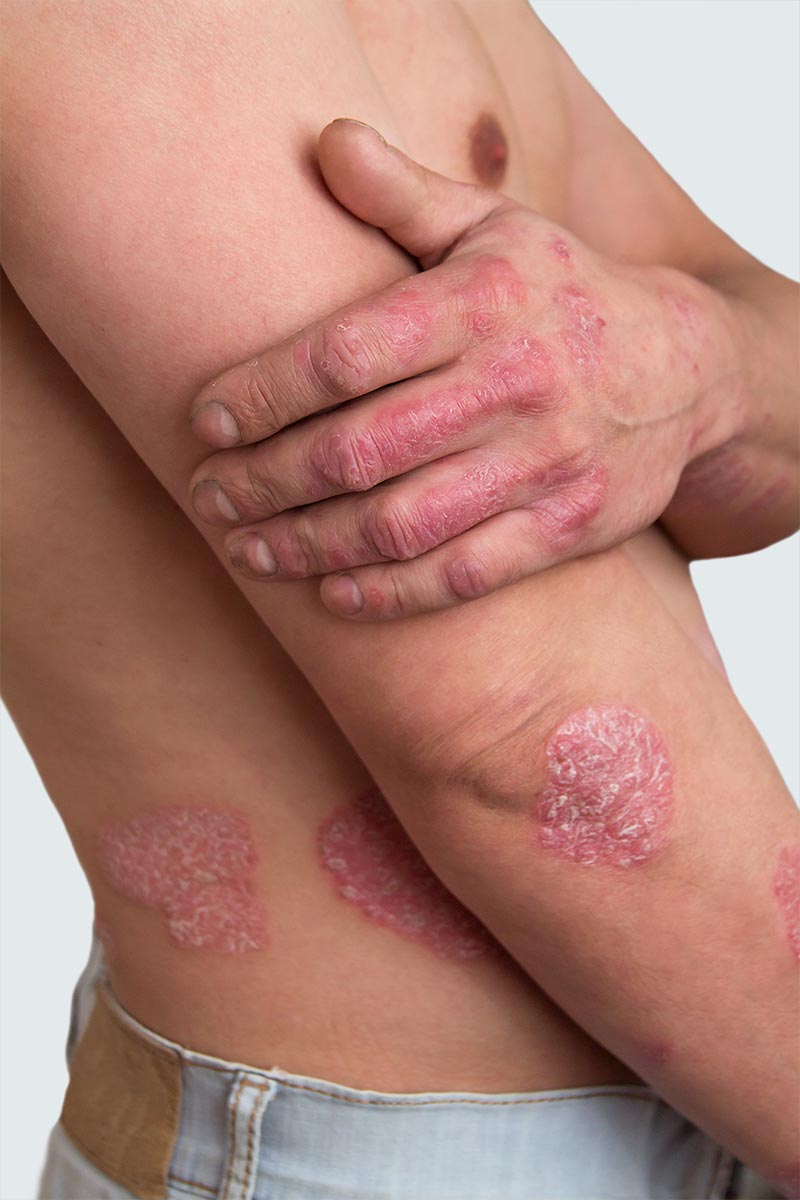
 Psoriasis is a chronic disease that affects approximately 2% of the population. Typically, new skin cells form over the course of few weeks. In people affected by psoriasis, skin cells form rapidly over a few days. The body does not shed this skin, so it builds up into raised pink plaques with silver-white scales.
Types of Psoriasis
Plaque Psoriasis
Plaque psoriasis is the most common form appearing in 80-90% of patients. It appears as patches of raised, round, red skin, and can be covered in silver-white scales. These patches can occur anywhere on the skin, and may be few or may cover the entire body.
Guttate Psoriasis
Guttate psoriasis occurs in about 2% of patients and is most common in individuals under 30. It appears as small pink bumps and occurs primarily on the trunk and parts of limbs close to the trunk. Guttate psoriasis often appears a few weeks after a cold, and can take few weeks to few months to clear. If you have plaque psoriasis and develop guttate psoriasis, it means your psoriasis is worsening.
Pustular Psoriasis
Pustular psoriasis looks like white pus-filled bumps surrounded by red skin. These bumps can be all over the body, or can be on just the palms of the hands or the soles of the feet.
Inverse Psoriasis
Inverse psoriasis looks raw with red, smooth patches. These patches develop only in the folds of the skin, such as the armpits or groin.
Erythrodermic Psoriasis
Erythrodermic Psoriasis is the least common form of psoriasis and causes severe redness and shedding of the skin. Fever and flu-like symptoms are common with this type of psoriasis.
Nail Psoriasis
Nail psoriasis can appear in all psoriasis types and affects the fingernails and the toenails. It causes tiny holes in the nails, which may cause them to loosen, thicken, and eventually crumble.
Psoriatic Arthritis
Psoriasis can also cause a specific type of arthritis. The first sign is frequently swollen, stiff, and sometimes painful joints upon waking up. If you are having joint pain or arthritis symptoms, please discuss this with your provider.
Triggers
Different people have different triggers. Common triggers include:
- Stress
- Strep throat
- A bad sunburn
- Trauma to the skin
- Smoking
- Obesity
- Some medications
Treatment
There are many options for treating your psoriasis. If your psoriasis is localized to a few body areas, we typically start with topical medications. For disease that persists despite topical treatments, or for more severe disease, we offer phototherapy at our office (we have both full body NBUVB and hand/foot NBUVB). Occasionally, we will need to treat psoriasis with more serious medications by mouth or with injections. These do have potential side effects which will be discussed with you. Your provider will help you to determine the best treatment plan for your psoriasis.