
 Moles are extremely common. In fact, almost every adult has a least a few moles. People with light skin tend to have more moles, sometimes 40 or more.
Most moles appear during the first 20 years of life, though some may not form until later. Sun exposure increases, and sometimes darkens, moles. During the teen years and pregnancy, moles may get larger and darker, and new ones may appear.
Types of Moles
Moles can appear anywhere on the skin, and come in all shapes and sizes.
Common/Normal Moles
Common moles are usually brown in color, but they can also be skin color. They may be flat and tan like a freckle, or they can be raised from the skin and very noticeable. They can even contain dark hairs.
Congenital Moles
A congenital mole is a mole that a person has from birth. About 1 in every 100 people will be born with a congenital mole. These moles can range in size from small to giant. Having a congenital mole increases a person’s risk of developing melanoma.
Atypical Moles
Dysplastic nevi, or atypical moles, are benign (non-cancerous) moles that can look like melanomas. Atypical moles usually have an asymmetrical shape; an irregular and/or hazy border; varied or irregular colors; and are typically larger than 6mm. Atypical moles are most commonly found on the back, chest, abdomen, and extremities, but can also occur on the buttocks, groin, breasts, or scalp. People with atypical moles may be at a higher risk for skin cancer and should be sure to self-examine their skin regularly.
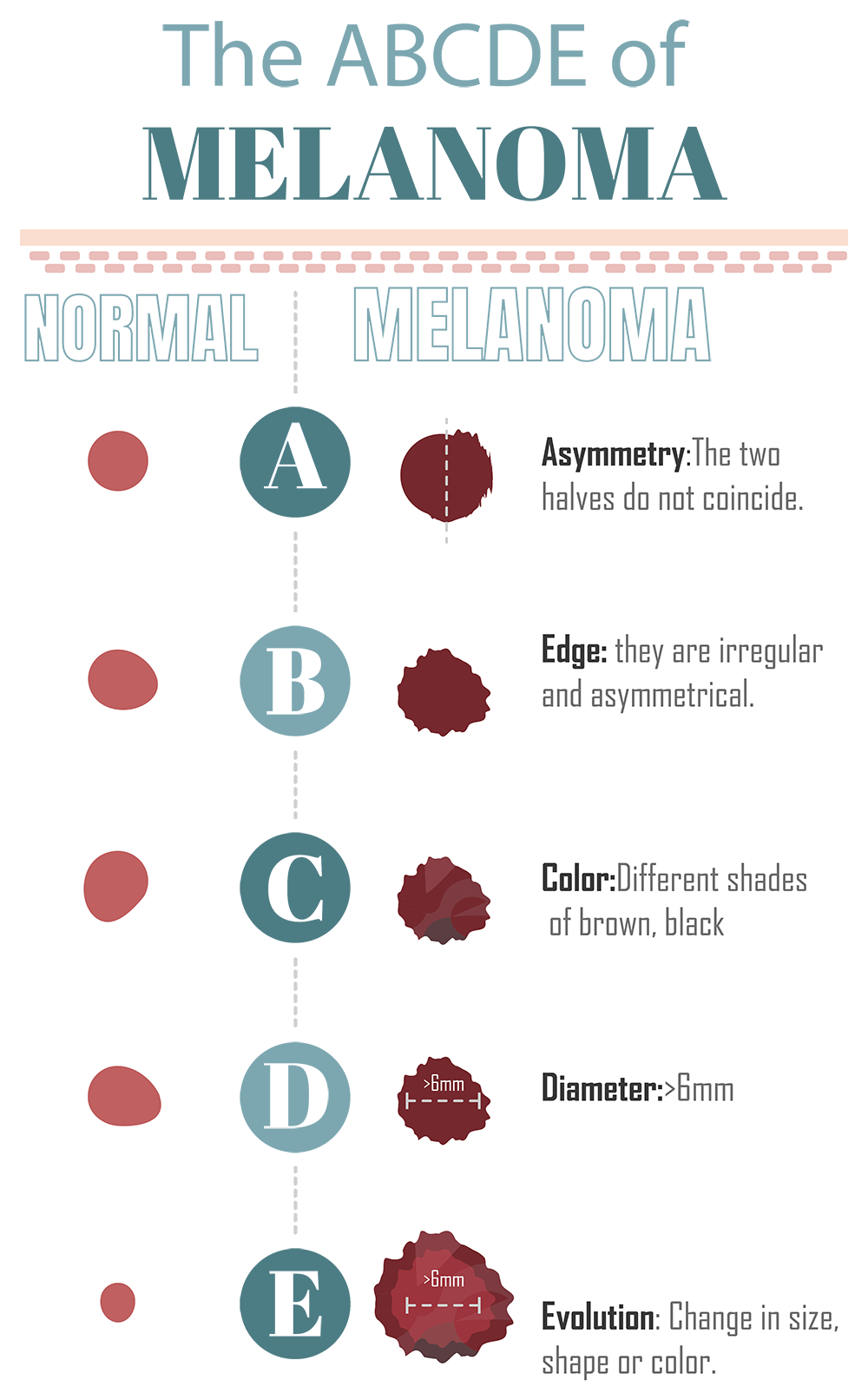
Signs of Skin Cancer
People with atypical moles are at a higher risk for developing skin cancer. Early detection is key in the treatment of skin cancer, specifically melanoma. When examining your skin, follow the ABCDEs of skin cancer to detect early signs.
- Asymmetry: A line drawn through the middle would not create matching halves
- Border: The mole has an irregular, scalloped, or poorly defined border that fades into the surrounding skin
- Color: The color of the mole varies or is irregular from one area to another, with shades of tan, brown, dark brown, red, blue, or black.
- Diameter: Melanomas are generally larger than 6mm (the size of a pencil eraser) when diagnosed, but can be smaller.
- Evolving: A mole or skin growth that looks different from the rest or changes in appearance (size, shape, or color) should be examined by your dermatologist.